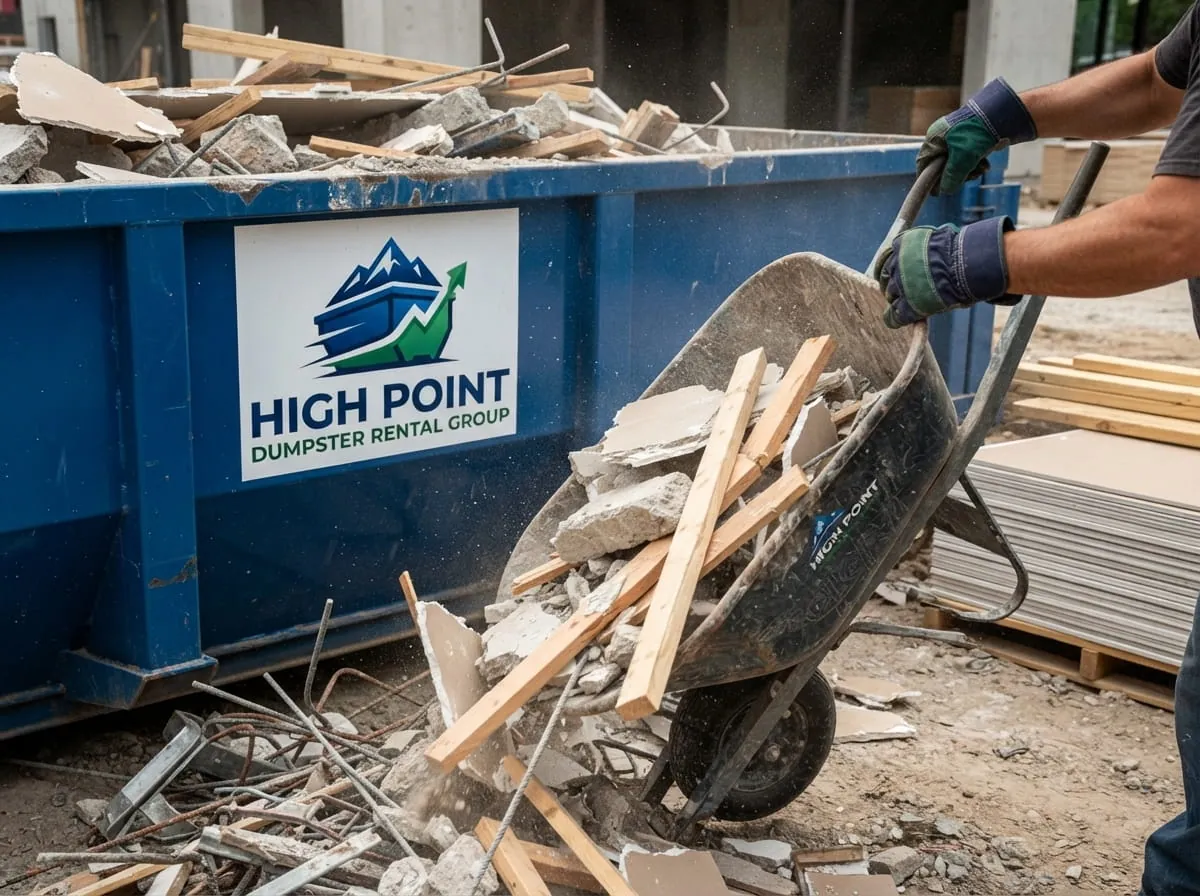
I have been dropping roll-off boxes on High Point driveways for a long time, and I can tell you that no other job rattles homeowners quite like a roofing tear-off. The dumpster shows up, the crew starts ripping shingles, and within an hour the thing looks half full and weighs more than a loaded pickup. Roofing debris is the heaviest material we haul, pound for pound, and if you do not plan the weight correctly you will blow past your tonnage allowance and get hit with overage fees that can rival the cost of the rental itself. This guide walks you through the math, the bin size, the placement, and the Piedmont-specific headaches so your re-roof goes smooth from the first bundle to the final nail sweep.
Why Roofing Debris Is So Much Heavier Than You Think
Most folks picture a dumpster filling up by volume. You look in the box, you see space, you assume you have room. Roofing does not work that way. A roll-off can look two-thirds empty and already be sitting at its legal weight limit, because asphalt shingles are dense. They are basically fiberglass mat saturated with asphalt and coated with ceramic granules, and water-logged old shingles are heavier still. When a crew tosses a square of tear-off into the box, that material packs tight and flat. There is almost no air in a pile of shingles the way there is in a pile of drywall or framing lumber.
This is the single biggest reason roofing jobs go sideways on the invoice. People rent a big 20 or 30 yard box thinking bigger is safer, fill it with shingles, and discover they have loaded fifteen tons into a bin rated to carry far less safely. The truck cannot legally haul it, we have to send a crew to pull material off, and the homeowner eats a reload charge plus overage tonnage. The smarter play is almost always a smaller, dedicated roofing bin.
The Shingle Weight Math Every High Point Homeowner Should Run
Roofing is measured in squares. One roofing square equals 100 square feet of roof surface, a 10-by-10 patch. Shingles come in bundles, and the bundle-to-square ratio depends on the product:
- 3-tab shingles: 3 bundles per square. Each bundle weighs roughly 60 to 70 pounds, so a single square of 3-tab tear-off runs about 180 to 210 pounds.
- Architectural (dimensional) shingles: also 3 bundles per square on most products, but the bundles are heavier, 65 to 80 pounds each. A square of architectural tear-off often lands between 230 and 250 pounds, and some premium laminated products push past that.
Now do the whole-roof math. A typical single-story ranch near uptown High Point might have 20 to 25 squares of roof. At roughly 250 pounds per square for architectural shingles, 22 squares is about 5,500 pounds of shingles alone, and that is just one layer. Add the underlayment, old flashing, rotten decking you decide to swap out, and the odd satellite dish mount, and you are comfortably over three tons for a modest house. A larger two-story or a steep complex roof on 35 squares can easily hit seven or eight tons on a single-layer tear-off.
Here is the rule I give every customer: estimate your squares, multiply by about 250 pounds for architectural or 200 for 3-tab, then add 15 to 20 percent for underlayment, nails, and moisture. That number in tons is what you actually have to plan the bin around. If you are not sure how to size the container against that weight, our guide on what size dumpster do I need breaks the decision down container by container.
Estimating Your Squares Without Climbing the Roof
You do not need to crawl around a wet Piedmont roof to get a usable estimate. If you know your home's footprint, take the square footage of the living space under the roof, divide by 100 to get a rough square count, then add a pitch multiplier. A low-slope roof adds almost nothing. A common 6/12 pitch adds about 12 percent. A steep 10/12 or 12/12 roof, which you see on some of the older two-story homes near High Point University, can add 25 percent or more because the actual sloped surface is much larger than the flat footprint beneath it.
So a 1,800 square foot footprint on a moderate pitch is roughly 18 squares times 1.12, call it 20 squares. Overhangs and dormers add a little more. When in doubt, round up your square count but keep the dumpster small and plan for the weight, not the volume.
Single Layer vs Multiple Layers: The Hidden Weight
This is where a lot of older High Point and Guilford County homes catch people off guard. For decades it was common practice to lay a second layer of shingles directly over the first instead of tearing off. If your house has been re-roofed once or twice that way, your tear-off is not one layer, it is two or three, and the tonnage doubles or triples accordingly.
Before you book anything, get up on a ladder at the eave and count the layers at the rake edge where the shingle stack is exposed. Two layers of architectural on 22 squares is not 5,500 pounds, it is closer to 11,000, and that changes everything about bin size and how many hauls you need. North Carolina building code generally limits you to two layers before a full tear-off is required, so if a crew finds a third layer up there, a complete strip-down is coming whether you planned for it or not. Older homes near the uptown core are the usual suspects for surprise layers.
Why a Dedicated 10 or 15 Yard Bin Beats a Bigger Box
Because roofing is so dense, the right container for a tear-off is almost always a smaller, lower-walled roll-off rather than the big construction boxes. A 10-yard dumpster or a 15-yard dumpster is purpose-built for heavy, compact debris like shingles, concrete, and dirt. The lower walls let a crew pitch material straight off the roof or a ladder board without having to lift it over a tall side, which keeps them moving and keeps shingles out of your flower beds.
A rough field guide: a 10-yard box comfortably handles a single-layer tear-off up to about 15 squares. A 15-yard box fits most single-layer jobs up to roughly 25 squares. Bigger than that, or any multi-layer tear-off, and you are usually better off with two smaller hauls than one overloaded big box, because the truck simply cannot legally carry the weight no matter how much air space is left. We would rather swap an empty box in mid-job than send a driver out with an illegal load. For the full lineup and weight allowances, our roofing dumpster rental page lays out exactly what each size is rated to carry.
Nails, Underlayment, and the Stuff That Is Not Shingles
A tear-off is more than shingles. Underlayment, felt, ice-and-water shield, old drip edge, flashing, ridge vent, and pounds and pounds of roofing nails all come off with the old roof. The nails are a real factor two ways. First, they add weight you did not count on. Second, they are the number one cause of flat tires in a driveway after the job wraps. A good crew runs a rolling magnet across the yard and driveway at the end of every day, and you should confirm yours does. Underlayment and felt are light individually but add up across a whole roof, which is part of why I tell people to pad their weight estimate by that 15 to 20 percent.
Protecting Your Driveway and the Street During Tear-Off
A loaded roofing box is one of the heaviest things that will ever sit on your driveway, and a lot of High Point driveways are older concrete or asphalt that can crack or indent under concentrated point loads. Before the box is set, we lay boards under the wheels and the rear roller to spread the weight. You can also ask for plywood or dunnage under the container. If your driveway is tight, steep, or newly sealed, tell us ahead of time so the driver can plan the drop. We have a full walkthrough on how to protect your driveway during a dumpster rental that is worth a read before the box arrives.
If the driveway will not work, the next option is street placement, and in High Point and across Guilford County that can require a permit from the city and some reflective cones or lighting at night. Do not guess on this. A box sitting illegally on a public street can get you a citation, and if a storm crew is working fast after a hail event, the last thing you want is a code officer slowing the job. We can walk you through local placement rules when you book.
Placement on Piedmont Lots
Most lots around High Point give us decent driveway access, but the Piedmont has its quirks. Mature hardwoods mean low branches that a roll-off truck has to clear on the way in. Clay soil that turns to soup after a thunderstorm means we avoid setting a heavy box on the lawn unless it is bone dry. And a lot of the older neighborhoods near uptown and the university have narrow drives and tight turnarounds. Set the box as close to the tear-off side of the roof as you safely can so the crew is not walking shingles across the whole property. Give the driver a clear, level spot and about 60 feet of straight approach if you can manage it.
Avoiding Overage Fees
Overage fees exist for one reason: weight. Every roll-off rental includes a tonnage allowance, and shingles blow through it faster than anything. The way to never see an overage charge is to do the square math up front, be honest about how many layers are coming off, and pick the bin and haul count around that weight rather than around how the pile looks. Do not top off a roofing box with other junk from the garage, that extra weight is what tips you over. And do not let a crew fill above the rim, an overfilled box cannot be legally tarped or hauled and has to be re-leveled on site.
If you tell us your square count and shingle type when you book, we will tell you straight whether one box or two makes more sense for your weight. That one conversation saves more money than any coupon. You can see our full container lineup on the roll-off dumpster rental page or browse all of our services to plan the whole project.
The Piedmont Roofing Season and Storm-Driven Re-Roofs
Here in the North Carolina Piedmont, roofing is practically a year-round trade, and the weather drives most of it. Our long humid roofing season runs deep into fall, but the real driver is storms. Spring and summer bring frequent severe thunderstorms, and with them hail and straight-line winds that chew up shingles. A single bad hail cell moving across Guilford County can generate hundreds of insurance claims and re-roofs in a matter of weeks. Late summer and early fall add the remnants of tropical systems pushing up from the Gulf and the Atlantic, dumping rain and wind that find every weak spot on an aging roof.
What that means for you is twofold. First, if you are re-roofing after storm damage, you are often on an insurance timeline, and having the right dumpster staged and ready keeps the crew moving before the next front rolls in. Second, demand for both roofers and roll-offs spikes hard right after a big storm, so booking your bin early matters. When a hail event hits High Point, our phones light up, and the homeowners who already knew their square count and had a box reserved are the ones whose projects do not stall.
Book Your Roofing Box the Right Way
Do the square math, count your layers, pad for underlayment and nails, and size the bin to the weight, not the look. A dedicated 10 or 15 yard box, placed with boards down and set close to the work, will carry you through a clean tear-off without an overage surprise. If you want a second set of eyes on your numbers before you commit, call the yard at (743) 229-5872 or reach us through our contact page, and we will get the right box on your High Point driveway when you need it.

Owner, High Point Dumpster Rental Group — sharing straight advice from years of local hauling across High Point and Guilford County.
Frequently Asked Questions
What size dumpster do I need for a roofing tear-off in High Point?
For most single-layer tear-offs, a 10-yard box handles up to about 15 squares and a 15-yard box handles up to roughly 25 squares. Roofing debris is dense, so you size the bin by weight, not by how much space is left. For multi-layer tear-offs or roofs larger than 25 squares, two smaller hauls are usually smarter than one overloaded big box. Tell us your square count and shingle type when you book and we will confirm the right setup.
How much does a square of shingles weigh?
It depends on the product. A square of 3-tab tear-off runs about 180 to 210 pounds, while architectural (dimensional) shingles land closer to 230 to 250 pounds per square. Multiply your square count by 250 for architectural or 200 for 3-tab, then add 15 to 20 percent for underlayment, nails, and moisture to get your true planning weight in pounds.
Why can't I just rent one big dumpster for my whole roof?
Because shingles are so heavy, a large box filled with roofing debris hits its legal weight limit long before it looks full. The truck cannot safely or legally haul an overloaded box, so we end up pulling material off and you pay reload and overage charges. A smaller, lower-walled 10 or 15 yard roofing bin, swapped out if needed, keeps you legal and avoids surprise fees.
How do I protect my driveway from a loaded roofing dumpster?
A loaded roofing box is extremely heavy, so we lay boards or plywood under the wheels and rear roller to spread the point load, which matters on older Piedmont concrete and asphalt. Tell us ahead of time if your driveway is steep, tight, or newly sealed. We also run a rolling magnet to sweep up stray roofing nails so you do not end up with flat tires after the job.
Do I need a permit to place a dumpster on the street in High Point?
If the box has to sit on a public street rather than your driveway, the City of High Point may require a permit along with reflective cones or lighting at night for safety. Placement rules vary, so do not guess, especially during the busy storm-repair season. We can walk you through local requirements for your address when you book so the project does not get held up by a code issue.