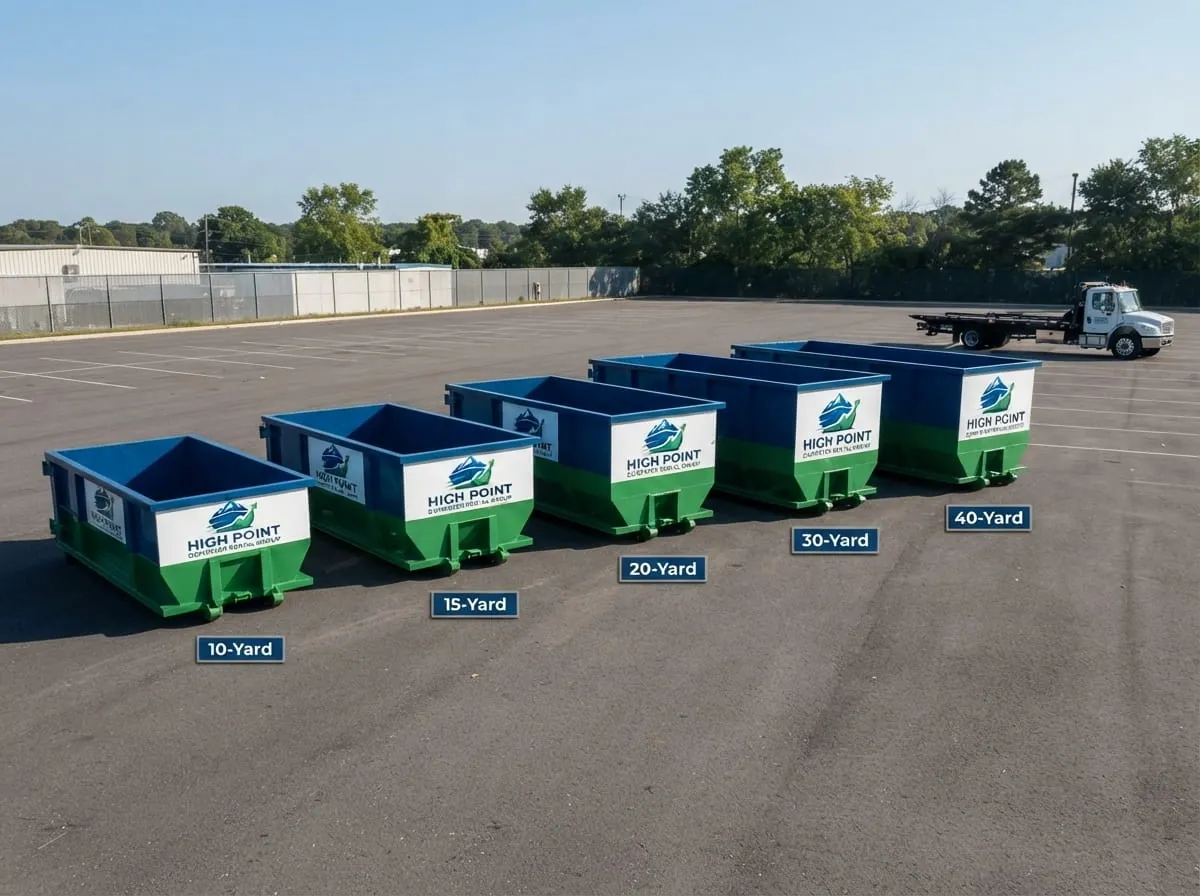
"What size dumpster do I need?" is the first question we field almost every day at High Point Dumpster Rental Group, and it's the right one to ask. Order too small and you're paying for a second haul or watching debris pile up beside a half-full bin. Order too big and you're renting air. After years of dropping roll-offs on red-clay lots from Oak Hollow to Jamestown, servicing showroom cleanouts around High Point Market, and hauling off roof tear-offs across Guilford County, we've learned that matching the container to the job is mostly common sense once you understand what each size actually holds.
This guide walks through the four roll-off sizes we run most often in the Piedmont Triad - 10, 15, 20, and 30 yards - with real dimensions, realistic capacities, the weight limits that trip people up, and which local jobs each one suits best. No fluff, just what we'd tell a neighbor over the fence.
Roll-Off Dumpster Sizes Explained
Roll-off dumpsters are measured in cubic yards, which describes volume, not weight. A "20-yard" bin holds roughly 20 cubic yards of loose debris. The number tells you how much space you get; it says nothing about how much that space can legally weigh when it rolls onto the truck. That distinction matters enormously in High Point, where our heavy red Piedmont clay, concrete, and asphalt shingles can max out the scale long before they fill the box. We'll come back to that.
Here are the containers we keep on the ground and the dimensions you can plan around. Actual sizes vary a little by manufacturer, but these are accurate for our fleet.
| Size | Approx. Dimensions (L x W x H) | Holds (pickup loads) | Best For |
|---|---|---|---|
| 10 yard | 12 ft x 8 ft x 3.5 ft | 3-4 loads | Heavy debris, small cleanouts, single-room demo |
| 15 yard | 16 ft x 8 ft x 4 ft | 4-6 loads | Mid-size cleanouts, flooring, bathroom remodels |
| 20 yard | 22 ft x 8 ft x 4.5 ft | 6-8 loads | Large cleanouts, roofing, multi-room renovation |
| 30 yard | 22 ft x 8 ft x 6 ft | 9-12 loads | Whole-home renovation, new construction, big estate cleanouts |
Notice that the 20 and 30 share a footprint - they're the same length and width, and the 30 is simply taller. That's handy to know when driveway space is tight: upgrading from a 20 to a 30 doesn't take up any more ground, it just gives you more vertical room for bulky, lightweight material.
The 10-Yard: Small Footprint, Big on Heavy Stuff
The 10-yard is our workhorse for weight. If you're tearing out a concrete patio, removing a brick walkway, hauling off red clay and dirt from a grading project, or stripping shingles off a modest roof, this is almost always the right call. Heavy debris fills the weight limit fast, so a small box with a low tonnage allowance keeps you from overloading. It also tucks neatly into the narrow driveways of the older brick homes near High Point University and uptown. Think single-bathroom gut, a garage purge, or a few pallets of broken concrete.
The 15-Yard: The In-Between Sweet Spot
The 15-yard is underrated. It holds meaningfully more than a 10 but still fits where a 20 might be awkward. We send a lot of these out for flooring tear-outs, a full bathroom remodel with tile and a cast-iron tub, mixed garage-and-attic cleanouts, and small deck removals. When homeowners aren't sure between a 10 and a 20, the 15 is often the honest answer - enough room without the waste.
The 20-Yard: The Most-Requested Size
If we had to pick one container as the all-purpose favorite in High Point, it's the 20-yard. It's the default for roof tear-offs on a typical ranch or two-story, kitchen-plus-bath renovations, large garage and basement cleanouts, and clearing out an estate's worth of furniture. It handles bulk well while still staying manageable in a standard driveway. Most multi-room remodels in the established neighborhoods around Emerywood and Oak Hollow land here.
The 30-Yard: Big Jobs and Bulky Loads
The 30-yard is for volume. New construction in the growing subdivisions out toward Jamestown and Sophia, whole-home renovations, major commercial cleanouts, and the big furniture and showroom clear-outs that come with the High Point Market cycle all call for a 30. Because it's tall, it swallows bulky, lightweight material - old sofas, pallets, display fixtures, drywall, framing lumber - without filling up on weight. If your debris is light and your pile is huge, the 30 earns its keep.
Weight Limits and Overage Fees - The Part People Miss
Every roll-off comes with an included weight allowance, measured in tons. Go over it and you pay a per-ton overage fee for the excess. This is the single most common surprise we help customers avoid, and it comes down to one idea: dense material weighs far more than it looks.
A 20-yard box loaded with couches and cardboard might weigh a ton and a half. That same box filled with wet red Piedmont clay, concrete chunks, or asphalt shingles could easily top 8 to 10 tons - well past any standard allowance and, frankly, too heavy to haul safely or legally. That's exactly why the industry puts heavy debris in small bins.
- Concrete, brick, asphalt, and stone: Book a 10-yard and fill it only partway. We'll tell you where the fill line is.
- Dirt and red clay: Same rule. Clay holds water, and wet clay is deceptively heavy, especially after one of our summer thunderstorms.
- Roofing shingles: A single "square" of shingles weighs 200-350 lbs. A full tear-off adds up fast, so size for weight, not just the pile.
Our advice: if the job is mostly heavy inert material, default smaller and plan on a partial fill. If it's mostly bulky household or construction debris, size up for volume. When in doubt, call us at (743) 229-5872 and describe the debris - we'll steer you to the size that keeps you under the limit. You can also compare rates on our High Point dumpster rental cost guide before you book.
Matching the Size to Your Job
Here's how the sizes map to the projects we see most often across the Triad.
Bathroom Remodel vs. Whole-Home Renovation
A single-bathroom gut - tile, vanity, tub, drywall - fits comfortably in a 10 or 15-yard. Add a kitchen and you're into 20-yard territory. A true whole-home renovation, where you're pulling flooring, cabinetry, fixtures, and walls throughout, calls for a 30-yard, and sometimes a swap-out when the first fills. For any sizable remodel, our residential dumpster rental service covers the driveway-friendly options.
Roof Tear-Off
Roofing is all about weight. For an average High Point home, a 20-yard handles a standard tear-off, but because shingles are so dense, we often recommend loading a 15 or 20 only to the fill line rather than cramming a bigger box. A steep or multi-layer roof may push you to stage the load. We'll size it with you so you don't blow past the tonnage.
Garage, Attic, and Estate Cleanouts
A single-car garage or an attic purge usually fits a 10 or 15. A packed two-car garage plus years of attic storage often needs a 20. Estate cleanouts - especially the furniture-heavy ones common in a town built on furniture - lean toward 20 or 30 yards because sofas, armoires, and mattresses eat volume quickly. If you're clearing a family home, size up; the stuff always adds up to more than it seems.
New Construction and Commercial
Framing scrap, drywall offcuts, packaging, and jobsite debris pile up fast on a build. New construction almost always means a 30-yard, sometimes on a scheduled swap cycle. For showroom resets, warehouse clear-outs, and High Point Market turnover, the 30 is standard. Our construction dumpster rental page covers jobsite scheduling and placement.
Local Factors in the Piedmont Triad
A few High Point realities worth planning around:
- Red clay lots: Any grading, landscaping, or excavation here means heavy, water-holding clay. Default to a 10-yard and keep it partial.
- Hot, humid summers and spring storms: Severe spring weather brings down limbs and causes water damage; storm cleanups often need a 20 for mixed yard and interior debris. Wet debris is heavier, so don't overfill.
- Established brick homes near HPU and uptown: Older, narrower driveways favor the compact 10 and 15-yard footprints.
- Growing subdivisions: New builds and additions out toward Jamestown and Sophia have the room and the volume for 20s and 30s.
- Furniture heritage: Showroom and warehouse cleanouts tied to the Market calendar are bulky but light - perfect for the tall 30-yard.
Still Not Sure? Call Us.
If you take one thing from this guide: size for weight when the debris is heavy and inert, and size for volume when it's bulky and light. Beyond that, a two-minute phone call usually settles it. Tell us what you're tearing out, where you are in Guilford County, and how much driveway you've got, and we'll put the right box on the ground - and only the right box. Browse all our roll-off dumpster rental options or review what you can and can't toss in our dumpster loading guide.
Ready to book or still have questions? Call High Point Dumpster Rental Group at (743) 229-5872 or reach out through our contact page and we'll match you to the perfect size today.

Owner, High Point Dumpster Rental Group — sharing straight advice from years of local hauling across High Point and Guilford County.
Frequently Asked Questions
What is the most common dumpster size for home projects in High Point?
The 20-yard roll-off is our most-requested size. It handles roof tear-offs, kitchen-and-bath remodels, large garage or basement cleanouts, and estate furniture clear-outs while still fitting most standard driveways. For a single room or a cleanout, a 10 or 15-yard is often plenty, and whole-home renovations or new construction usually call for a 30-yard.
Why should I rent a small dumpster for concrete, dirt, or red clay?
Because dense material weighs far more than it looks. Concrete, brick, asphalt, dirt, and our red Piedmont clay can max out a dumpster's weight limit long before the box is full - and an overloaded bin is unsafe and often illegal to haul. We put heavy, inert debris in a 10-yard and fill it only to the marked line to keep you under the tonnage allowance and avoid overage fees.
What are the dimensions of your roll-off dumpsters?
Our 10-yard runs about 12 ft long x 8 ft wide x 3.5 ft high, the 15-yard about 16 x 8 x 4, the 20-yard about 22 x 8 x 4.5, and the 30-yard about 22 x 8 x 6. The 20 and 30 share the same footprint - the 30 is simply taller - so upgrading for bulky, lightweight loads doesn't take up any more driveway space.
What happens if I go over the dumpster's weight limit?
Each roll-off includes a weight allowance measured in tons. If your load exceeds it, you pay a per-ton overage fee on the excess. The best way to avoid it is to match the size to the debris - small bins for heavy material like concrete, shingles, and clay, and larger bins for bulky but light material like furniture and framing. Call us and describe your debris and we'll size it to stay under the limit.
What size dumpster do I need for a roof tear-off in High Point?
For an average High Point home, a 20-yard typically handles a standard shingle tear-off, but roofing is heavy - a single square of shingles weighs 200-350 lbs. Because of that weight, we often recommend loading a 15 or 20-yard only to the fill line, or staging the load for a steep or multi-layer roof. Tell us your roof's size and layers and we'll recommend the right container.